
Download our Health and Physical Wellbeing Leaflet
This downloadable leaflet brings together key information about the physical health and wellbeing of individuals living with Smith-Magenis syndrome. It highlights common and less common medical concerns, outlines what families and professionals should be aware of, and explains when further monitoring or specialist input may be needed. Our aim is to support early awareness, informed conversations with healthcare teams, and confident care that promotes the best possible health outcomes across childhood and adulthood.

The guidelines below were developed by the Scientific and Clinical Advisory Group of the Smith-Magenis Syndrome Foundation, U.K. They are aimed at health care professionals working with individuals with Smith-Magenis Syndrome, and will be reviewed and updated at regular intervals.
Routine Monitoring
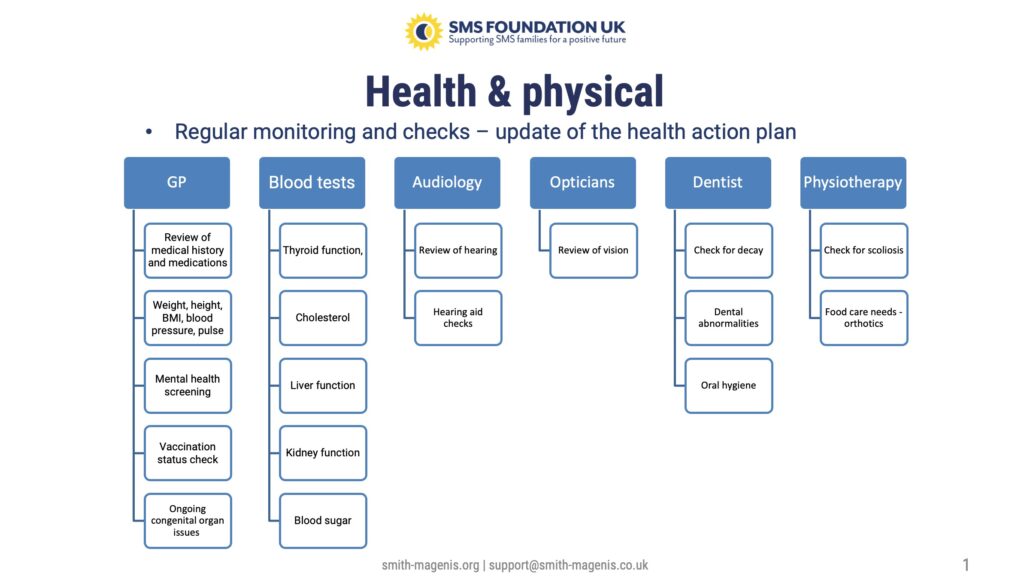
Download regular monitoring health checks as PDF
Over and above the routine health and vaccination schedules administered to all children, we recommend consideration of the following:
On diagnosis:
Physical and neurological assessment and examination
Clinical Area Investigation/Assessment Reason
Growth, Feeding & Nutrition
- Height and weight centiles
- Feeding evaluation – examination of palate, assessment of swallowing, oral motor skills, gastroesophageal reflux, caloric intake.
- Referral to specialist feeding team if indicated
- short stature and/or failure to thrive in 78% of cases;
- tracheobronchial problems in 50%).
Cardiac
- cardiac examination including echocardiogram,
- Cardiac problems in over 30%.
Renal
- Renal ultrasound
- renal/urologic anomalies in over 30% of cases
Immune System
- Assessment of Immune function if presenting with frequent infections
- decreased IgG or IgA in over 30% of cases).
Hearing
- Assessment for conductive and or sensorineural hearing loss.Grommets or hearing aid may be indicated.
- 60% have hearing problems – 65% conductive, 35% sensorineural
Ears, Nose, Throat
- Otolaryngologic evaluation to assess ear, nose and throat problems, with specific attention to ear physiology and palatal abnormalities
- velopharyngeal insufficiency in 75%, cleft in 10%).
Eyes
- Ophthalmologic examination with attention to evidence of strabismus, microcornea, refractive error, retinal detachment.
Spine
- Assessment for scoliosis
- in over 60% of those aged 4 years and over
Genetics
- Individuals with larger deletions®screen for adrenal function ®assessment of nerve conduction velocity if the gene PMP22 is involved.
- gene PMP22 is involvementassociated with hereditary neuropathy with liability to pressure palsy.
Genetics
Referral to Clinical Geneticist for parental chromosome analysis and provision of genetic counselling.
Sleep difficulties
Sleep history to document the sleep cycle and evidence for sleep apnea, snoring and other signs of sleep abnormalities. Actigraphy, if available, is a useful non-invasive method of capturing sleep-wake cycles in the home environment over a period of time. Any concerns about snoring or irregular night-time breathing should prompt a full polysomnography and ENT evaluation.
Behaviour difficulties
Consider referral to Clinical Psychology or Learning Disability CAMHS services for detailed assessment and intervention.
Family support
The child’s/adult’s behaviour and sleep difficulties may be chronic, and in many cases support from Social Services Learning Disability Services, Child Development Team staff (e.g. keyworker), Child and Adolescent Mental Health Services, Voluntary Organisations and Parent Support Groups may be helpful.
Annual assessment
- Monitor for scoliosis
- Thyroid Function
- Consider ophthalmologic evaluation
- Audiologic evaluation at regular intervals or as clinically indicated to monitor for conductive or sensorineural hearing loss
- Periodic assessment of presence of challenging behaviours and referral for treatment as needed
Management of Sleep Difficulties
Management of sleep disorders is likely to include behaviour management, and may also include melatonin at night and possibly beta blockers or phototherapy in the morning. The timing of such interventions is likely to be very important and may vary from child to child. No formal controlled trials of these latter interventions have been conducted to date. However, they are the subject of much research interest and discussion. Referral to a specialist sleep service might be indicated.
Management of Challenging Behaviours
For challenging behaviours, including aggression, self injurious behaviours and impulsivity/hyperactivity, both conventional behaviour therapy and pharmacological treatments should be considered, though these behaviours are often very difficult to treat.
These guidelines have been compiled by
Dr Daphne Keen
Prof Paul Gringras
Dr Alison Male
Dr Orlee Udwin
Scientific and Clinical Advisory Group of the Smith-Magenis Foundation.
July 2009.
A Guide to SMS Booklet
Our booklet ‘Smith-Magenis Syndrome: Guidelines for Parents and Teachers’ provides a lot of practical and helpful advice about coping with all aspects of SMS. It covers sleep, social relationships, behaviours, feeding difficulties, toilet training, dressing, school concerns, behaviour in adulthood, siblings and sources of further help.
 Understanding Cerebral Visual Impairment (Webinar Recording)